Tuesday, November 15, 2016

Shut In

Despite its official IMDB categorization, and almost every descriptor out there for the movie, make no mistake, Shut In is only mildly thriller; the rest is straight-up horror. This does not, unfortunately, make it a particularly good movie. It's too confused with itself between those two facets of its identity, but it's beautifully shot and features some lovely actors doing the best they can with an implausible script.

Shut In (2016)
Released: November 11, 2016
Director: Farren Blackburn
Screenplay: Christina Hodson

Tagline: "Don't believe everything you see"

Cast:
Naomi Watts as Mary Portman
Charlie Heaton as Steven Portman
Jacob Tremblay as Tom Patterson
Oliver Platt as Dr. Wilson
David Cubitt as Doug Hart

Our story centers around Mary, played by the beloved Naomi Watts, a widowed child-psychiatrist whose home and practice are located deep in the woods of northern Maine. Working out of her garage, Mary rarely leaves her home because her stepson Stephen, played by Charlie Heaton of Stranger Things, has been rendered almost entirely paralyzed by the car accident that killed his father, Mary's husband. 

To no one's surprise, a snowstorm of Westeros proportions is barreling down on the area and could potentially leave Mary without power for several days. One of Mary's patients, a 9-year old deaf boy with severe, even violent, tendencies named Tom (played by adorable actor Jacob Tremblay of Room (2015) fame, runs away from his foster care home on the night the storm is set to move in, sending Mary on a desperate scramble to find him before the storm arrives in full force. But then, strange things start happening in the house. Unexplained noises. Furniture out of place. Sinister visions at night. 

So begins a psychological mind game where the viewer is left to wonder if Tom is already hiding in the house, if it is his ghost, or if Mary is quietly beginning to lose her mind after the mental strain of taking care of her son and the guilt she feels in her decision to send him to an assisted living center after the storm. This is a great concoction brewing here, but it comes out sour. Instead, a predictable twist that was done better in a film earlier this year, The Boy, is what the viewer is left with. 

"Blink twice if Eleven's coming back next season"

Throughout the film, Mary's own psychiatrist, Dr. Wilson, tells her about all the different pills she needs to start popping because she's dumb or whatever, and then he ends up revealing the twist to the audience over Skype, which was anticlimactic and frustrating since Mary, who had been fighting back against him the entire time, now starts giving in to every basic horror cliche that make true genre fans scream. And speaking of anticlimactic, that big giant White Walker storm? It doesn't show up until the final fifteen minutes of the movie and then it has no bearing on the remainder of the plot in any way. Cool.

To be fair, I don't think anyone expected Shut In to be all that grand. It was stealth released without any advance screenings for the press, so you know that's always a red flag. But sometimes giving in to low expectations can yield diamonds in the rough so I thought, why not? It's not awful--and there are some fun nods to The Shining (1980) and Jacob's Ladder (1990)--but it is very, very average. Which, at this time of year, you just can't be if you hope to make any money. So I'd say wait on this one and spend your money at the theater on this year's various Oscar bait movies or, if you want to support a horror director, Dr. Strange by Scott Derrickson (Hellraiser: Inferno, The Exorcism of Emily Rose, Sinister, Deliver Us From Evil, Sinister 2). 


Shut In (2016)
5-Totally Terrifying
4-Crazy Creepy
3-Fairly Frightening
2-Slightly Scary
1-Hardly Horror

Saturday, August 27, 2016

Don't Breathe

You'll be hard-pressed to find a more aptly titled film this year than Don't Breathe, director Fede Alvarez's simplistic but suspenseful sophomore effort that provides most, but not all, of the thrills and scares provided in the spoilery trailer. Besides that, the incredible use of sound, set pieces, and a solid cast giving their best all make for a deliciously wicked cocktail of a film, even if the aftertaste is a tad bitter.


Don't Breathe (2016)
Released: August 26, 2016
Director: Fede Alvarez
Screenplay: Fede Alvarez & Rodo Sayagues

Tagline: "This house looked like an easy target. Until they found what was inside."


Cast:

Stephen Lang as The Blind Man
Jane Levy as Rocky
Dylan Minnette as Alex
Daniel Zovatto as Money

Don't Breathe is, undoubtedly, a tense thrill ride, which his an impressive feat to pull off for a number of reasons, not least of which that the somewhat-spoilery trailers let us know much more than the basic premise. The film centers around a trio of down and out urban youths and petty thieves who make their cash by robbing wealthy homes of their valuables and electronics in bleak and desolate Detroit.  They decide to rob the home of a blind Gulf War veteran living in an otherwise abandoned suburb, thinking it'll be an easy score, but find that after they've broken into the house and blasted open a suspiciously locked door, they took on more than they bargained for in this particular heist.


As evidenced, the plot is simple, but that works in the film's favor. Little of the movie is wasted on nonsense or pointless characterization. Alvarez is adept at showing us only what we need to advance the story into the next frame while still giving his actors room to flex their roles. The cinematography is gorgeous, with some artful camera angles and skewed shots that add to the atmosphere of this flipped tale of the home invasion sub-genre. the camerawork makes the story feel epic in scale, even though we're confined to the very real-world setting of this decaying urban landscape, and the even realer setting of the house, which is made to feel like a labyrinth of twisted proportions thanks to the set design and clever tracking shots.


Marco?

Vital to the success of any great horror film is sound, from the infamous score in John Carpenter's Halloween (1978) to recent successes like It Follows (2014), sound can elevate a horror film to new, tense heights. In Don't Breathe, it's more the lack of sound that accomplishes this same feat in building the perfect, very particular atmosphere, needed for some of the film's most crucial moments. Which of course would also fall flat if not for the solid, strong talent of the actors, all of whom give very physical performances that ground the reality of the situation and help knock up the terror. Dylan Minnette provides a noticeably mature and believable performance in his role as level-headed Alex while Daniel Zovatto shines, albeit briefly, as Money, and the trio is anchored with a stalwart performance from Jane Levy, the film's de facto heroine. But Stephen Lang, in his performance as The Blind Man, steals the show, proving once again why he's so uniquely skilled at playing the villain. Lang adds depth, dimension, and even empathy to a character who might otherwise come off as inhumane in the hands of a lesser actor.

Yet for all this, I have to say that Don't Breathe still had its missteps. One of which occurred in the very opening shot. We open (with an awesome crane shot that tracks down into the suburban streets of Detroit) with a last-act revelation that offers up the fate of our characters, before then flashing back to watch the path that led here unfurl. And while this choice of opener doesn't detract of tense moments within the film, it detracts from the overall tension, as we know how things end up already. For me, this was a major detraction. I wish that Alvarez, or the studio, would trust the audience with a natural progression of story rather than unnecessarily opening on violence to "hook us." I couldn't help thinking that without this flash-forward scene, I would have been so much better positioned to have a rich, participatory experience with the movie. If you haven't seen it yet, I would honestly advise doing what you can to get to the theater a minute or two late. Your viewing will be much more "clean" that way.

Fro-yo after this, though?

Overall, Don't Breathe delivers. It's one of the better horror films of the year, combining slow burn tension with gut-punch terror and a sort of beautiful brutality. The Witch (2016) might be the "better" horror film for its atmospheric virtues, but Don't Breathe is the clear jolt fest. Alvarez wanted to prove wrong the critics who said he couldn't make an original horror movie without relying on blood and gore after his directional debut, the Evil Dead (2013) remake, and he succeeded. This film shows that he has a resourceful understanding of suspense, and a brilliant mind for what will get audience pulse racing. One scene in particular, a sequence shot entirely in night vision that is merciless and dripping with dread (not to mention a nice nod to Silence of the Lambs (1991) am I right?) is some fantastic filmmaking. Ironically, though, the film needed more restraint, or at least the marketing did. The trailers and promotions give away two of the movie's "twists" or turns in the storytelling, and the opening scene, as mentioned, needs to be cut, but there is one final surprising element that leads to one of the most disgusting moments in recent horror history. And if you're all about the journey, this is one hell of a ride for you. And you'll certainly need to catch your breath when it's over.


Don't Breathe (2016)
5-Totally Terrifying
4-Crazy Creepy
3-Fairly Frightening
2-Slightly Scary
1-Hardly Horror

Tuesday, September 1, 2015

Screams and Nightmares: Wes Craven Remembered

The man knew how to get into our nightmares, and stay there. A wholly dignified man who exuded an academic air in interviews and on film, always with a soft smile and kind eyes, Wes Craven was an imaginative and innovative director whose creations shaped and re-shaped the horror genre time and again over the course of his blood-spattered 40-year career. 


Craven's teacher-like qualities are often cited by those he worked closely with on projects over the years as one of the great qualities the director possessed, and can likely be traced to the fact that prior to turning to filmmaking in his late twenties and early thirties, Craven was a humanities professor. His attraction to horror was born from an unlikely environment; Craven was raised in a strict, fundamentalist, Baptist household outside Cleveland, Ohio, where he was taught that the outside world was a place of deep and aggressive sin and that he was, at all costs, to avoid sex, drugs, and the cinema. In his youth, the man who would one day fashion one of the 20th century's most chilling boogeymen was only allowed to watched Disney cartoons at home.

But as all true horror fans know, the lure of the forbidden is seductive, urgent, and powerful, and after college, Craven developed a passion for films, and particularly the most taboo of genres: horror. As he expressed many times during his career, film allowed him to express the repressed emotions from his childhood that he kept so long under the surface. Once he had left academia, Craven entered the world of filmmaking through a not-unfamiliar seedy sidedoor: the New York City X-rated grindhouse industry, which was in its heyday during the late 1960's. After a short time churning out fast-and-cheap sleazefests for the trench-coat wearing crowd, Craven finally managed to make the switch to horror, another genre deemed disreputable in the halls of Hollywood, but he never forgot the lessons he learned from directing pornography, namely that limits are there to be pushed, and that there's room for art in all types of filmmaking.

Craven made his directorial debut with The Last House on the Left (1972), a film that very much took advantage of the fact that the Production Code had been dropped in 1968. Featuring the now famous tagline, "To avoid fainting, just keep telling yourself 'It's only a movie. It's only a movie,'" The Last House on the Left was a brutal film, featuring an unrelenting barrage of violence, rape, murder, and revenge centering on an insane posse of sadists that torment and violate a pair of young women, and the pair of parents that then enact some equally vicious revenge on the perpetrators. A loose remake of Ingmar Bergman's The Virgin Spring (1960), Last House remains difficult to watch even in our current desensitized age. It is a landmark horror film made all the more unnerving that it is easy to forget it's just a movie, but still a movie that stands as a harrowing portrayal of the savagery and inevitability of violence.

Craven was a staunch believer that horror films did not create fear, they released it, that they were mechanisms by which the audience could be freed from their deepest anxieties, and throughout his career, films such as drive-in classic The Hills Have Eyes (1977) and Deadly Blessing (1981) exemplified this while also showcasing Craven's growing technical talents. But it was Craven's best-known movie, A Nightmare on Elm Street (1984) that would launch him to new horror heights. Craven took the teen body-count slasher flick template and spun it on its head to dig beneath the quaint surface of the Reagan era and unearth blood, bodies, and secrets. 


Now a horror classic, and the progenitor of a nine-film franchise, Nightmare follows a group of teens haunted in their dreams by the razor-taloned, horribly burned and demonic Freddy Krueger, a child killer slaughtered in an act of vigilante justice. A touchstone of the slasher decade, Craven's film was both a meditation on the murderous instincts ingrained in the adolescent subconscious and another commentary about how violence works in an endless cycle. What was perhaps so distressing and so terrifying for audiences far and wide about this particular Craven creation was that the violence was centered in an idyllic, small-town setting, and the seemingly safe suburban streets of middle America were now turned into a hunting ground. After all, every town has an Elm Street. 

This and Nightmare's memorable villain--who would go on to join Michael Myers and Jason Voorhees in the Big Three of slasher killers--helped the film stand out amongst the glut of 1980's brand-name horror. The success of Elm Street allowed Craven to enjoy an inventive and creative period, out of which came many of his best underrated but consistently terrifying gems, like the sinister, voodoo-centric Serpent and the Rainbow (1988), his monster movie Shocker (1989), and his fairy-tale urbanoia horror The People Under the Stairs (1991). He would eventually return to the Elm Street franchise for the series' seventh installment, New Nightmare (1994) and once again, a Freddy film would prove to be an influential turning point in Craven's career. 

Playfully postmodern, New Nightmare was a Freddy movie cheekily aware of the Freddy movies in which Heather Langenkamp, real-life star of the first film, plays herself and becomes increasingly convince that Freddy Krueger has found a way to manifest himself in the real world. Full of dark humor, Hollywood satire, folklore, a sense of unnerving dreaminess, and genuine moments of horror, the film is among the best of Craven's career, and acts as a sort of dress rehearsal for his meta-slasher box office hit, Scream (1996). 


As a dissection and a dissertation on the genre, Scream was an old-fashioned whodunnit informed by the conventions, tropes, and expectations of slasher films, with the added element of characters that had a scary movie-savvy knowledge of those conventions. The film combined intelligence with horror and introduced us to another Craven creation that has since reached the status of legendary horror icon--Ghostface, who knew all the cliches and conventions of the horror film. The killer returned, albeit always with a different identity under the mask, along with Craven in three sequels, each entry a commentary on horror filmmaking (in Scream 2 (1997) the killer's focus in sequels, Scream 3 (2000) trilogies, and Scream 4 (2011) remakes and reboots). 

The massive success of the Scream franchise allowed Craven to venture beyond blood-and-guts filmmaking, as he did with Music of the Heart (1999), but the film, beyond earning Meryl Streep an Oscar nomination, was not a success and though he occasionally expressed regret about not being able to work outside the horror genre more often, Craven never let his work feel confined and films of his later years like Red Eye (2005) and My Soul to Take (2010) show him eagerly plumbing new and fearful depths as he had in his early days. His calling was never melodrama, it was terrifying audiences, even after the credits rolled, and he was damn good at it. 

We'll never scream quite the way we used to at a Wes Craven film.


Friday, October 3, 2014

Dolls

Dolls are found in cultures and households all over the world. Girls, boys, and even adults make them, play with them, and collect them. Perhaps it's this universality that can make the idea of these little stuffed, plastic, or porcelain beings so eerie. Do we ever really know what our playthings get up to when we're not looking? Toy Story (1995) used this quandary to light and humorous effect, but the horror genre has an altogether different idea as to what these dolls are really all about once their masters are tucked safely in bed. From dirty little teddy bears to possessed clowns, dolls are a source of much murder and mayhem in horror films, under the right circumstances. 

This month's Annabelle (2014), a spin-off/sidequel of last year's horror mega-hit The Conjuring (2013), follows in a long line of demonic dolls and predatory puppets. So if you want to spend this Halloween season on a nostalgic look back at your dollhouse days, try a few of these films featuring stuffed terrorizing tykes to get you in the mood…and then burn every doll that you've ever owned.


Attack of the Puppet People (1958)
Rushed into production after the success of The Incredible Shrinking Man (1957), this film features a lonely and deranged puppeteer/inventor who designs a machine capable of shrinking people into real-life dolls he then adds to his "special collection." A drive-in B-horror/sci-fi mesh, the film was trashed on release but was noted for having somewhat of a cliffhanger ending and has since gained a cult following.

Devil Doll (1964)
An evil hypnotist/ventriloquist, the "Great Vorelli," plots to gain and heiress' millions with the help of his very-much alive dummy, Hugo. Though not at all praised by critics, the film did feature William Sylvester, who went on to appear in 2001: A Space Odyssey (1968) as Heywood Floyd. 


Magic (1978)
A favorite among many in the horror community, Magic revolves around a ventriloquist (played by Anthony Hopkins) trying to renew his romance with his high school sweetheart, played by Ann-Margaret, while being stuck under the thumb of his foul-mouthed and vicious dummy, Fats. A psychological horror at its heart, Magic is less evil-dummy-come-to-life and more about the dangerous mental decline of the protagonist (the doll is, in actuality, a manifestation of Hopkins' character's repressed psyche, the primal id). A classic among true horror fans.

The Pit (1981)
A young outcast befriends a dirty stuffed bear, who proceeds to lead him to a mysterious pit in the local woods where a ravenous monster resides. Hated and bullied by both the children and adults in his community, young Jamie is convinced by "Teddy" to do all sorts of unsavory things to please the creature, including feed it by luring unsuspecting victims to the spot. 

Black Devil Doll from Hell (1984)
A blaxploitation horror film about woman who purchases a remarkable doll at a magic shop, not knowing that the doll is possessed by an evil spirit who is hellbent on residing in a new, more lifelike body--hers. 


Dolls (1987)
A personal favorite at this time of year, Stuart Gordon's Italian-American classic Dolls focuses on a group of six people, among them little Judy Bower, stranded at a secluded manor during a thunderstorm. The mansion, owned by the toy-making Hardwickes, is inhabited by a haunted collection of dolls. At some times the film is stuck more as an idea than a moving engine, but the house is one of the most magnificent sets in horror, and the Hardwickes are one of the creepiest horror film duos you'll find.

Child's Play (1988)
Familiar now to even the most casual of horror film fans, Child's Play tells the story of a single mother who gives her son a beloved doll for his birthday, only to discover that the doll is possessed with the soul of a slain serial killer; the inaugural debut of one of horror's most iconic villains, Chucky. 

PIN (1988)
A doctor acquires a lifelike, anatomically-correct medical dummy, with all the muscles and organs visible through its clear skin, nicknamed Pin (after Pinocchio). Via ventriloquism, Pin explains bodily functions in a way that children can relate to and learn about the body. After the over-strict doctor and his wife are killed in a car crash, his son Leon transfers his alter-ego into Pin, whom he always believed was alive. Leon starts using Pin as an excuse to over-protect and control his sister Ursula, shielding her from "unwanted" admirers, even to the point of committing murder.


Puppet Master (1989)
Shunned psychic Neil Gallagher finds the secret hiding place of legendary puppeteer Andre Toulon. When the puppets come to life, he commits suicide, leaving his former friends, all psychics as well, to investigate and unravel the mystery behind the murderous puppets, who have strange abilities ranging from dangerous drills to coughing up leeches. This first installment in the franchise spawned nine sequels, with rumors of more to come.

Dolly Dearest (1991)
An American family moves to Mexico when the father becomes the new owner of the Dolly Dearest toy factory. Unfortunately for them, the factory happens to be right next to an entrance to the tomb of Sanzia (meaning Satan on earth), so when an archaeologist breaks the entrance open, an old, malicious spirit is set free to take possession of the dolls and wreak havoc.

Silent Night, Deadly Night 5: The Toy Maker (1991)
The final installment in the Silent Night, Deadly Night franchise, Mickey Rooney plays an old toy maker who, with his son, fashion killer toys designed to murder their owners, children. Rooney publicly derided the first entry in the series, yet choose to accept a role in this installment, generally regarded as one of the worst horror films ever made.

Demonic Toys (1992)
A policewoman, her quarry, and an innocent delivery boy become trapped in a haunted toy warehouse. Produced by Charles Band, the creative mind behind Puppet Master, the film is loved by some, hated by others, though everyone is generally confused by the time-traveling spirits who function as a deus ex machina. Band decided to cross the toys over with the title character of the science fiction Dollman (1991) movie in Dollman vs Demonic Toys (1993) than later with Toulon's creations in Puppet Master vs Demonic Toys (2004) before finally making a direct sequel, Demonic Toys 2 (2010). 


Pinocchio's Revenge (1996)
Defense attorney Jennifer Garrick acquires a Pinocchio puppet from a condemned serial killer, which is never a good idea. Her pre-teen daughter, Zoe, mistakes the puppet as a birthday present, as pre-teen daughters named Zoe are want to do, and subsequently grows rather attached to her new wooden friend. Then, accidents begin to happen to those who cross Zoe, with Zoe blaming the doll, and her therapist convinced otherwise. In time, Zoe and Pinocchio converse about his bad behavior, and the doll swears to stop if only Zoe will cut his strings. Zoe complies, and the body count begins…

Amityville Dollhouse (1996)
A children's dollhouse, modeled after the infamous haunted Long Island residence, is given to a young girl after she and her parents move into their newly constructed house. When the girl discovers a small chest in the dollhouse containing handmade dolls, a demonic evil is unleashed and begins a new reign of terror. The eighth installment of the Amityville Horror series, the film received poor reviews and was not a success on home video.

Blood Dolls (1999)
Another killer toy adventure from Charles Band, Blood Dolls focuses on Virgil, an eccentric and freakish billionaire who is now spending his days as a "biological inventor." His latest brainwave, the "blood dolls," aid him in getting revenge on those who have betrayed him.

The Dummy (2000)
A ventriloquist's dummy brought to life now has a mind of its own, and that mind is pure homicidal. He begins to cut a bloody swath through a peaceful suburb, essentially just for the hell of it.


Doll Graveyard (2005)
In the early 1900's, young Sophia plays all by herself in her large, creepy house with only four handmade dolls as friends. When her abusive father forces her to bury the dolls in the backyard, Sophia suffers an accident and is buried alongside them. In the present, a father moves in with his son and daughter, constantly at odds. When the girl and her friends torment her younger brother, Sophia's lost dolls return, ready to take revenge on behalf of the bullied boy.

Dead Silence (2007)
A widower returns to his sinister and near-forgotten hometown to search for answer's to his wife's violent and mysterious murder, which he discovers may be linked to the ghost of a vengeful ventriloquist, Mary Shaw. Starring Ryan Kwanten pre-True Blood (2008-2014) and Donnie Wahlberg, and directed by James Wan of Saw (2004), Insidious (2010), and The Conjuring fame, Dead Silence was a box office dud, but has become popular in a large section of the horror community. 

Ooga Booga (2013)
A quasi-spin off of Doll Graveyard, this film follows an innocent African American boy who is brutally murdered by dirty cops and whose soul is then magically transferred into a traditional (stereotypical?) African warrior action figure named Ooga Booga. Revenge-laden antics ensue.


Honorable Mentions
While the following films do not feature dolls as the center of the plot, a creepy doll of some kind plays a minor role, whether it be as the focus of a segment in one of the anthology films, or otherwise frightening the characters in the film in some manner.

Dead of Night (1945)
The Twilight Zone, season 5, episode 6 "Living Doll" (1963)
Asylum (1972)
Trilogy of Terror (1975)
Poltergeist (1982)
Tales From the Hood (1995)
May (2002)

Wanna play?

Thursday, August 14, 2014

Jaws

It was the prototypical summer blockbuster. A cultural and entertainment phenomenon whose ripples can still be felt almost 40 years later. It reshaped the structure of the movie industry and doomed an entire generation to always question just how safe it really is to venture out into the open water…


Jaws (U.S.A.)
Released: June 20, 1975
Director: Steven Spielberg
Screenplay: Peter Benchley & Carl Gottlieb (based on the novel Jaws by Peter Benchley)

Tagline: "Don't go in the water"

Cast: 
Roy Scheider as Police Chief Martin Brody
Richard Dreyfuss as Matt Hooper
Robert Shaw as Quint
Lorraine Gary as Ellen Brody
Murray Hamilton as Mayor Larry Vaughn

It's not uncommon for those who have seen this toothy tale to have images from the film flash across their mind every time they take a dip in the ocean…or a lake…or a river…or in a swimming pool. I used to have a recurring dream as a child that every time I went underwater in my own pool I would see a great white shark barreling towards me from the other end, despite the water being crystal clear if you were above water…and the fact that, you know, it was a pool and not the freaking Atlantic.


The story that has terrified so many is a simple one. Based on the best-selling novel by Peter Benchley, Jaws (1975) centers around the quaint coastal community of Amity Island, whose survival depends on summer tourism. After a suspected shark attack, Police Chief Martin Brody wants to close the beach, but the mayor worries that the bad publicity will ruin the annual July 4th celebrations, the most important weekend for the islanders. When a second attack claims the life of a child, Brody finds himself facing the animosity of the very citizens he has sworn to protect. Eventually, he teams up with a marine scientist, Hooper, and a colorful local fisherman/bounty hunter, Quint, to track down the rogue great white shark that has been bedeviling the silver waters of Amity Island. Aboard the Orca, the three men find that this particular great white shark is more resourceful, powerful, and committed than they ever would have guessed.

Director Steven Spielberg fashions a beast that is primarily nuanced and hidden throughout the film, an avatar of revenge. But as in the case of Alfred Hitchcock's The Birds (1963), the motivation for that revenge is not immediately apparent. For example, there's the fact that this rapacious sea dragon arrives in Amity thirty years to the day after the dreadful "Indianapolis incident" which occurred on June 29-30, 1945. Quint describes, in detail, that crisis in the film: the day that his ship delivered an atom bomb to Japan. Given this anniversary, some fans have suggested the notion that the shark could be more than mere animal--a supernatural angel of death come to achieve what its finned, black-eyed brethren at the Indianapolis incident could not: the death of Quint, one of the American men who brought death and destruction to entire cities. And now the shark is not only after Quint, but is bent on hitting America where it hurts most: our economy. 


"I'm only trying to say that Amity is a summer town.
We need summer dollars"-Mayor Vaughn (Murray Hamilton)

Cinematically, Jaws derives much of its terror from what one might term "information overload." Although the great white shark remains hidden beneath the waves for most of the film, unseen but imagined, Spielberg fills in that visual gap and the viewer's imagination with a plethora of facts and figures about this ancient, deadly predator. Legendarily, the life-size mechanical model of the shark nicknamed Bruce malfunctioned repeatedly during the film's production, a reality that forced Spielberg to hide the creature from the camera for much of the time. Yet this problem worked in the film's best interests. For much of the first two acts, unrelenting tension builds as a stream of data about the "monster" washes over us.

After a close-up imagine of a typewriter clacking out the words "SHARK ATTACK," images, illustrations, and descriptions of the shark hurtle across the screen in ever-increasing numbers. Brody reads from a book that shows a rendering of a shark as a boat-destroying, ferocious sea monster. Another schematic in the same scene reveals a graph of shark "radar," the fashion by which the shark senses a "distressed" fish, its prey, far away in the water. Additional photos in the book, and shown full-screen by Spielberg, depict the damage a shark can inflict: victims of shark bites both living and dead. These are not photos made up for the film, but authentic photographs of real-life shark attack victims. At one point, Quint even draws a shark with a human inside its giant maw, a cartoon version of learning and fear. Taken all together, there images cover many aspects of sharkdom: from reputation to lore, to impact on soft human flesh. The information about sharks also comes from eyewitness testimony: Quint describing the aforementioned Indianapolis incident in horrific detail during, arguably, the film's most powerful segment.

This information overload build up the threat of the film's villain to an extreme level, while the actual beast remains silent, unseen. When the shark does wage its final attack, the audience has been rigorously prepared and it feels frightened almost on reflex. Thus, Spielberg has managed to create, from scratch, an educated audience, one that fully appreciates the threat of the great white shark. His clever filmmaking continues, however, when, even after all this education and knowledge and information, Spielberg unexpectedly harks back to the mythological aspect of sea monsters, hinting that this is no ordinary shark, but a real survivor, a monster potentially supernatural in nature. In the end, facts are unimportant, as Brody, Quint, and Hooper face down an old-fashioned, seemingly indestructible monster. 

"All this machine does is swim, and eat, 
and make little sharks" 

Combining the "keep the beaches open" Watergate conspiracy in the film with the Indianapolis story (a story, essentially, of an impotent, abandoned military), one can detect in Jaws a story about America's 1970's "crisis of confidence," to co-opt a phrase from President Jimmy Carter. After Watergate, after Vietnam, there was little faith in the elected leaders (much like today), and Jaws mirrors that reality with an unforgiving depiction of craven politicians and bureaucrats. The cure is also provided, however: the heroism of the individual, the old legend of the cowboy who rides into town and seeks justice. Brody is clearly that figure here, an outside in the corrupt town of Amity--he doesn't even like the ocean--who puts his fears aside to face the enemy head-on. Yet Brody was also involved in the initial cover-up, but then again, Americans don't like their heroes too neat. Brody must have a little blood on his hands so that his story of heroism is also one of redemption.

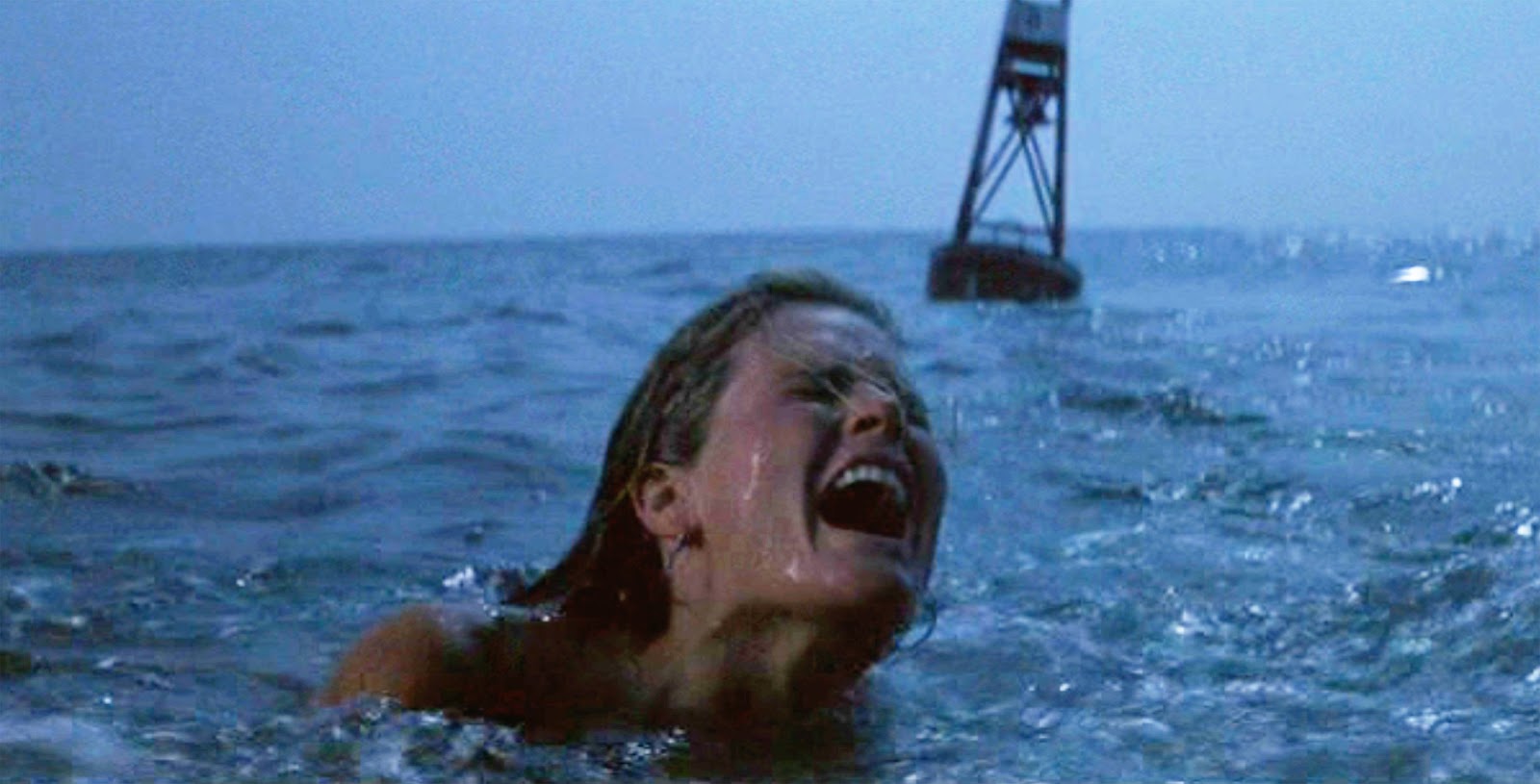
In part, Jaws remains legendary because of its opening sequence. This introduction to the world of the film features a teenager going out for a swim in the ocean and getting the surprise of her life. The scene is pitch-perfect both in orchestration and impact. The film begins under the sea as Spielberg's camera adopts the P.O.V. of the shark itself. The camera clings to the bottom of the ocean as it moves inland. Cut to the beach, a long, lackadaisical establishing pan across a typical teenage party. Smoking, drinking, canoodling, a spirited and youthful summer night. One girl, Chrissie, atypical blonde-haired 1970's goddess, breaks from the group, and Spielberg cuts abruptly to a high angle from a few feet away, a shot that signifies danger and distances us from the individuals onscreen. With her horny but drunk companion in tow, Chrissie disrobes for a nighttime dip in the sea, and the new angle is far below her, from the bottom of the ocean looking up. Her nude form cuts the surface above--a callback to Jack Arnold's Creature from the Black Lagoon (1954), where the monster spied lovely Julie Adams and dances with her (without her knowledge) in the murky lagoon. But that is an image of a more romantic age. In this case, the swimmer is nude, not garbed, and her contact with the monster is quick and fatal. In a horrifying close-up shot, the camera registers Chrissie breaking the surface as something unseen but immensely powerful tugs at her from below. Once. Then again. After an instant, the audience realizes that the shark is eating her, ripping through her legs and torso. She begs God for help, but as one might expect in the secular, post-"God is dead" 1970's, there is no help for her.

In the best tradition of the horror genre, this scene is also oddly beautiful. The gorgeous sea, the blithe human forms moving in rhythm, the nighttime lighting. In short, everything about this moment should be romantic and wonderful. But it isn't. Spielberg takes the "malaise days" mood of the nation to generate his aura of terror, overturning traditional order, just as our belief in the United States as a "good" and powerful nation had been overturned by national traumas like the war in Vietnam and the Watergate scandal. Perhaps this is one of the reasons Jaws pulled in record-breaking numbers during its initial run in theaters. The true legacy of Spielberg's film is not the three sequels that followed, of rapidly dwindling quality (Jaws 2 [1978] sees Brody return to rescue trapped teenager sailors from a second great white, Jaws 3 [1983] involves a great white attacking a Sea World-type environment and starred Dennis Quaid, and Jaws: The Revenge [1987] defies all logic and believability by featuring a shark that apparently declares revenge on every surviving member of the Brody family), but in how the success of the film reshaped the movie industry, and pop culture in general. After Jaws, and the box office gross it made for Universal, studios turned their attention to making bigger and better summer popcorn movies, a trend that continues with debatable success to this day. 
"This was no boat accident"

Of course, Jaws has also helped perpetuate the stereotype that all sharks, including great whites, are vicious, man-eating predators, when in reality, sharks tend to avoid humans on principal, and if attacks do occur, sharks do not often consume the victim whole, but rather take an exploratory bite, disregard the taste of human, and leave. In the wake of Jaws, "monster-fishing" became a widespread hobby, and self-made "heroes" made it their business to hunt down and kill great white sharks, even though an attack had not been reported in the United States in over thirty years. For a time, the great white shark was in danger as a species, and is still somewhat hunted down with prejudice today, perhaps from viewers who cannot shake the nightmare images of the unnaturally vengeful shark they saw in Spielberg's film.

Jaws is at once political and economic allegory, and a back-to-basics pure adrenaline-pumping horror film that forces the audience to confront deep-seated fears about the water and of being eaten, of being consumed by a force greater than man. Yet is is also an adventure film, one of the first action-horrors, that channels Spielberg's Indiana Jones films more than it does any of the subpar rip-offs that followed it, like Piranha (1978). For the world's first "blockbuster", there are a surprising amount of layers hidden here, if you look deep enough…

Care for a swim?


Jaws (1975)
5-Totally Terrifying
4-Crazy Creepy
3-Fairly Frightening
2-Slightly Scary
1-Hardly Horror

Friday, June 13, 2014

Friday the 13th

Camp Crystal Lake, 1958. A pair of teenage (horny) camp counselors sneak off to enjoy an intimate moment of privacy. But they only get as far as making out before they are killed by an unknown, off-screen, assailant, the murders acting as a brutal revenge killing for the accidental drowning of a young boy, Jason, the year prior. This is the familiar opening sequence, mostly shot from the point of view of the killer, to one of the great slasher kings and a true classic of horror genre, Friday the 13th (1980).

Friday the 13th (U.S.A.)
Released: May 9, 1980
Director: Sean S. Cunningham
Screenplay: Victor Miller

Tagline: "If you think this means bad luck…you don't know the half of it"

Cast:
Adrienne King as Alice Hardy
Harry Crosby as Bill
Peter Brouwer as Steve Christy
Laurie Bartram as Brenda
Kevin Bacon as Jack Burrel
Betsy Palmer as Mrs. Voorhees

After the first two bodies drop, the film skips ahead twenty-one years to find a young couple and a group of new, teenage counselors settling down in the remains of the deserted summer camp that played host to the tragedy, ready to repair and revitalize the secluded campground. But they have not been heeding the warnings of the Crystal Lake locals, particularly those of Crazy Ralph (Walt Gorney)--doomed to always be heard, but never believed--when they are cautioned that if they stay too long at "Camp Blood," they will not come back. When a secret assailant starts offing the kids one-by-one, counselor and sensitive artist Alice is left to fend for herself in the midst of a powerful thunderstorm before the murderer is revealed in one of classic horror's great twists. 

If John Carpenter's Halloween (1978) blew the horror genre wide open by starting the slasher boom, Friday the 13th provided the template most of its successors would slavishly follow, with all of those witless teens wandering off alone at night to be graphically skewered by farm tools and sporting goods. Though director Sean S. Cunningham and writer Victor Miller certainly jumped on the Halloween bandwagon, they produced, at little expense, a glossy and quirky rip-off that proved to stand alone as a quality imitation. 

What makes Friday the 13th work, and what helped it stand out when it was released, was its killer twist ending and use of a remote, backwoods location. Crystal Lake is visualized as an idyllic American town, one filled with abundant pastoral and natural beauty. Early scenes in the film document this beauty, creating an almost Rockwellian vision of the surrounding area. These visualizations serve a crucial purpose, because the film largely concerns innocence lost or destroyed. The curse of "Camp Blood" lets us see that Crystal Lake has now become a Garden of Eden-type-setting, beauty now corrupted because two camp counselors allowed an innocent child to drown while making love--they lose their biblical innocence and a child loses his life. At the same time, Mrs. Voorhees loses her son, and therefore her innocence, along with her mind (as we later learn). Take, for instance, the scene involving the snake in the counselor's cabin--a snake in the garden, as it were--that is promptly decapitated by a counselor's machete, putting an end to the threat and restoring order. Symbolically, this scene is echoed in the film's bloody denouement as the final girl, Alice, lops of the head of a much more dangerous snake in the garden, the killer, also utilizing a machete. In both cases, we get the idea of natural order overturned by the presence of evil--a serpent, specifically--and then order is restored, even if the respite is brief.

It can be quaint when there's not various limbs strewn about

By essentially retelling Halloween's story in a remote environment, Friday the 13th managed to cement the slasher sub-genre for years and years to come. By enshrining the "rules" that Halloween established, from the killer with a vengeful agenda to the secluded, disturbed idyll, to the final girl running across all of her dead friends in a literal "tour of the dead," the film signaled a shift in horror as a whole, as made evident by the abundance of sequels that followed (ten movies followed, plus the remake in 2009, and there's a second reboot on the way next year, which will be the thirteenth Friday the 13th), and a return to the brand-name monster horrors of the 1930's. Though only present briefly in this first installment (that's right, he doesn't actually show up until Friday the 13th Part II [1981] and doesn't wear the infamous hockey mask until Friday the 13th Part III [1982]), Jason Voorhees has become an icon of the horror genre in the same vein as Dracula, Frankenstein's Monster, The Mummy, and the Wolf Man. 

Of course, the film is not without its faults. Though the graphic violence does its job in making the audience feel like victims, thanks in large part to special effects artist Tom Savini, who arrived at Crystal Lake straight from the Monroeville Mall and his work on Dawn of the Dead (1978), the direction is nothing special, and the revelation of the killer, who is shown to have hairy hands and large work boots and is strong enough to heft a corpse through a window, does not play logically (even if it is shocking on first viewing). Additionally, horror fans have debated for years if Friday the 13th is even suspenseful at all,  if the story is too weak and padded to allow for true feelings of terror. 

What most F13 fans do agree on, however, is the clever use of the camera in the film. Following in the footsteps of films like Psycho (1960), Peeping Tom (1960), Halloween, and even Mario Bava's Bay of Blood (1971), Friday the 13th forces the viewer to see through the killer's eyes as the teenagers are observed from the shadows. Often positioned outside cabins or bathhouses, the camera looks at the characters through windowpanes. Outside the windows is only darkness, since the setting is motley nighttime. But inside the buildings, the characters are brightly lit and attending to their business, unaware of danger. This pervasive composition reveals not merely the voyeurism of the killer as they stalk their prey, but also visually constricts the space of the protagonists within the rectangular frame, literally boxing them inside a series of smaller and smaller boxes as the film progresses. In the tightest, most claustrophobic of those boxes, our heroes go about their business without realizing their world has become limited and closed off by the invisible presence of the slasher nearby.

He won't be kicking off his Sunday shoes anytime soon

Filming techniques like this have become standard in the slasher sub-genre, and in horror in general, and even if you don't find the film all that suspenseful, it's hard not to twitch just a little when characters blindly walk into a bloody death while staring straight at the camera, a fact that the audience can recognize and anticipate but that the characters cannot.  Little stylistic choices like these, or the abundance of "danger" and "warning" signs hanging about the decrepit, abandoned campground, make Friday the 13th a slasher that will always be a cut above the rest. 

All of the tropes seen here may seem familiar to us now, perhaps even overdone, especially since Friday the 13th is now considered fascinating not for being a stand-alone film, but for spawning a successful and highly profitable franchise, even though most of the sequels are best avoided and present less interesting filming techniques and discussion than the original. Cunningham's film can still probe the mind of seasoned viewers and horror newbies alike, making us ask what exactly is meant by the cop who warns the counselors that he will not tolerate "weirdness." It it a surface jibe at authority? Or only a mask for the conservatism that sees virginal Alice as the sole survivor and the killer's motivation revolving around punishment for sex. And what exactly is the relationship between nature and man in this story of a paradise lost? Full-on assaults on the body are conducted under a heavy thunderstorm, pounding rain and lightning, the "invader" to the garden arrives with natural cover, with the help of a force beyond this world. And so it "rains blood" at Camp Crystal Lake again, and the viewer must ask if the storm is a manifestation of the killer's rage? A protest against the unnecessary death of an innocent child? God's tears over a mother's love turned to violence? Or does He send the storm as a cover for the murderous campaign to succeed?

The first Friday the 13th is more than mere dreck, because it features some visually accomplished moments and a smattering of interesting symbolism. Not least of all, the film conforms to the slasher format's best aspect. It reminds the viewer that even if the boogeyman is at the door, they can survive. And they can do it with the qualities they already possess in spades, intelligence and insight. 

Tranquility restored, or the calm before the storm?


Friday the 13th (1980)
5-Totally Terrifying
4-Crazy Creepy
3-Fairly Frightening
2-Slightly Scary
1-Hardly Horror

Tuesday, April 1, 2014

April Fool's Day

In recent years, April Fool's Day (1986) has developed a semi-cult status among a pocket of dedicated slasher flick horror fans. This is largely in part due to the film having just the right amount of smarts to hold up fairly well over the years, even if some of the tension and suspense falls flat. More a mystery in the vein of And Then There Were None than an outright slasher, the film is satisfying enough for the seasoned horror fan and still accessible enough to not scare off the novice--in fact I often recommend this as a starter film for those who want to get into the slasher sub genre of horror.

April Fool's Day (USA)
Released: March 27, 1986
Director: Fred Walton
Screenplay: Danilo Bach

Tagline: "Don't let the joke be on you"

Cast:
Deborah Foreman as Buffy/Muffy St. John
Amy Steel as Kit Graham
Ken Olandt as Rob Ferris
Deborah Goodrich as Nikki Brashares
Leah Pinsent as Nan Youngblood
Clayton Rohner as Chaz Vyshinski
Thomas F. Wilson as Arch Cummings
Griffin O'Neal as Skip St. John

It's easy to classify the 1980's as the decade of the slasher film. The boom noticeably started with John Carpenter's Halloween (1978) and was further propelled to success by Friday the 13th (1980) and A Nightmare on Elm Street (1984), not to mention each of their many sequels and knock-offs. A string of holiday-themed horror also sprung up around this time, most of them slashers, and there did not seem to be a holiday on the calendar that was immune to having a maniac serial killer stake claim to it. April Fool's Day, helmed by Fred Walton, director of the original When a Stranger Calls (1979), was one of many such films, but was better than most.

The film centers around a group of college students heading to their wealthy friend's island summer home to enjoy Spring Break. Of course, the island is only accessible by ferry, and when a series of April Fool's pranks go awry, a boat-hand is seriously injured and rushed to the hospital. From there, the mood begins to darken after one of the friends goes missing. The group splits up (because of course they do--it's a slasher movie from the 80's, let's be real), but the search only results in more guests missing…but their heads turn up in due time. 

The film succeeds thanks to the efforts of the cast and the writing. The dialogue is clever at most points, and the characters are well-written and realistic enough that you come to like them even if they're not the most admirable of people. Most of the actors were horror regulars (Amy Steel from Friday the 13th fame) or unknowns, and this works to the film's advantage. Deborah Foreman's underrated performance is a fun viewing experience, balancing out sweetness and quirkiness in a way that has become all too familiar now.

"Three cheers for mullets and no muscle tone!
We love the 80's!"

As the body count rises and things escalate into a frenzied chase around the house, April Fool's Day moves into new waters and uncharted territory, throwing in twists, turns, red herrings, and surprise endings. Yes, that's plural. The ultimate revelation of the film has divided horror fans for years, either completely turning off some viewers, or sealing their dedication entirely. The twist is well-written, and is almost certain to surprise you, and offers a unique viewing experience in that you feel stuck, unable to move or think, for a solid 60 seconds after the final twist is unraveled. 

Regardless of the ending, the film has a lot working for it, including an eerie soundtrack and a fast-paced script that turns the movie into an Agatha Christie novel on steroids. The only fault lies in some of the larger moments of tension, where the execution just misses the mark and leaves the viewer's heart rate ramped up without payoff. This is a dangerous drawback to have, however, especially in the horror genre, and it's likely what relegated April Fool's Day to the under-the-radar-hidden-gem corner of the world of horror. Not that that's an inherently bad corner to be in.

All in all, April Fool's Day is a great starter film for the horror newbie, or the practical jokester, though just be sure that you can outsmart anyone you watch this movie with, as it certainly gives one ideas…

"Play nice today, children…"


April Fool's Day (1986)
5-Totally Terrifying
4-Crazy Creepy
3-Fairly Frightening
2-Slightly Scary
1-Hardly Horror